Materials under coastal pressure
Wind, rain, salt spray and cycles of damp and drying put pressure on buildings close to the sea. Timber is common across many northern landscapes because it is workable and widely used, but coastal construction varies by region, period and available materials. Stone, brick, rendered surfaces and metal details also appear in different combinations.
Paint protects exposed timber and changes how a street reads, but colour alone does not identify a building’s age or status. Maintenance choices can reveal the practical needs of a property. Look closely without touching surfaces or entering private land.
Houses and village streets
Homes may face a road, harbour or sheltered garden rather than the open sea. A compact street can reflect access to a landing place, land ownership or the topography of the shore. Other settlements are linear, following a road or narrow strip of higher ground.
Windows, roof forms and outbuildings should be interpreted in context. A detached shed may be storage, workshop space or a later addition. Similar details appear across borders, but local building practice is not uniform. Avoid assigning a style or date without reliable evidence.
Boat sheds, piers and working infrastructure
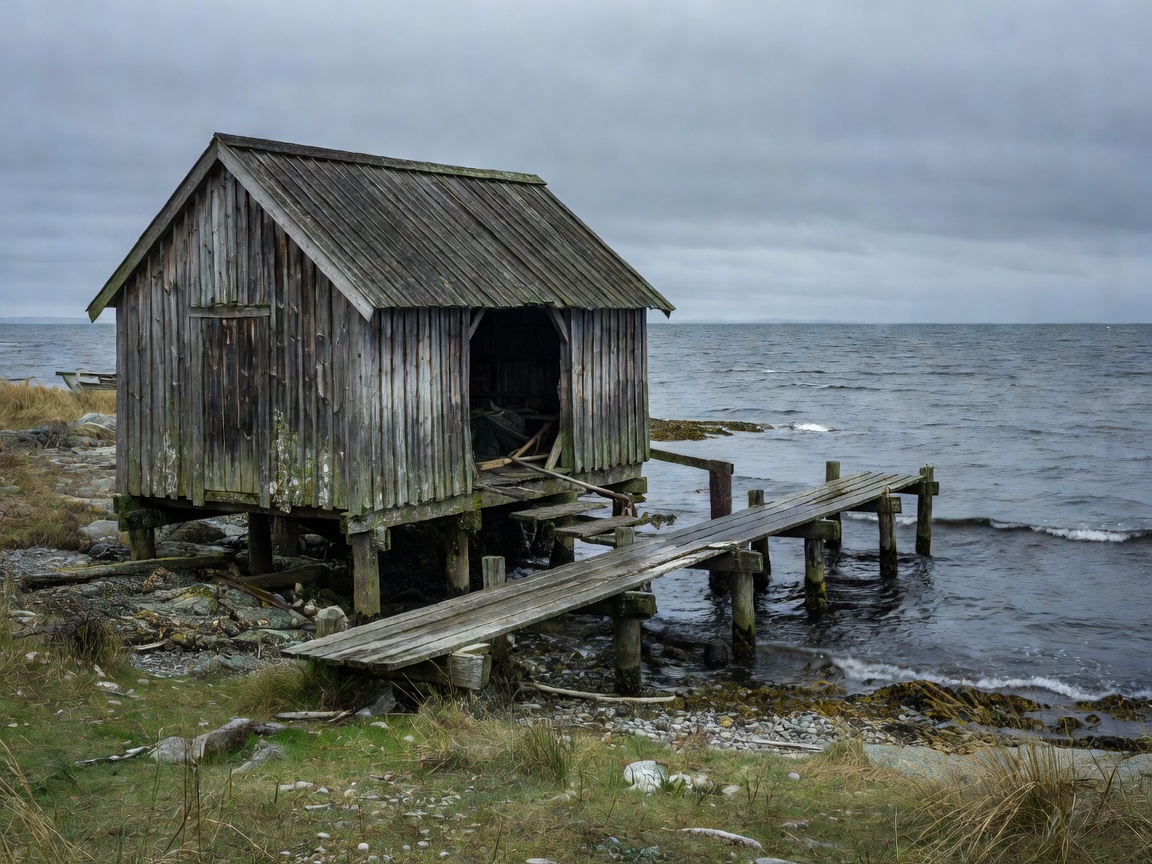
Boat sheds protect craft and equipment from weather. Their position often balances water access, wind shelter and the available plot. In a working harbour, piers and ramps are infrastructure, not just scenery. Keep clear of lifting gear, vehicles, mooring lines and restricted areas.
Harbour shape can range from a small sheltered basin to a simple pier or landing. Some waterfront structures are active; others have been adapted for storage, community use or visitor access. Current use does not necessarily explain original use, so read interpretation from local sources where available.
Adaptation without assumption
Buildings change as livelihoods and household needs change. A former work building may be repaired for another use, while a residential property may gain extensions or modern services. Adaptive reuse can keep a structure useful, but it should not be romanticised as proof of a single continuous tradition.
Access restrictions and ownership matter. Do not enter buildings, yards or piers unless access is clearly public or permission has been given. Cultural heritage information and formal protection status should be verified through the relevant local authority; this guide does not designate buildings.
Compare the waterfront to its setting
On exposed shores, shelter and maintenance are immediate concerns. In archipelagos and sheltered inlets, the relationship between buildings and landing places may be different. Sandy coasts, rocky edges and low wet ground each shape where structures can be placed and how visitors move through a settlement.
Estonia, Latvia and Lithuania each have distinct building histories. Finland and Sweden include extensive island settings; Denmark, Germany and Poland add other coastal patterns and port histories. Treat these as contexts to investigate, not a checklist of national styles.
Good for
These notes help walkers notice how villages connect homes, roads and water. They also support photography, local-history research and slow visits where the goal is to understand how a waterfront functions rather than collect façades.
What to know
- Buildings and waterfronts may be private or operational.
- Never climb on boat sheds, piers or sea defences.
- Do not assume a building is protected or historic without verification.
- Photograph from public places and respect residents’ privacy.
For settlement context, read the village guide. To learn about working traditions and community spaces, continue to culture and local traditions.